
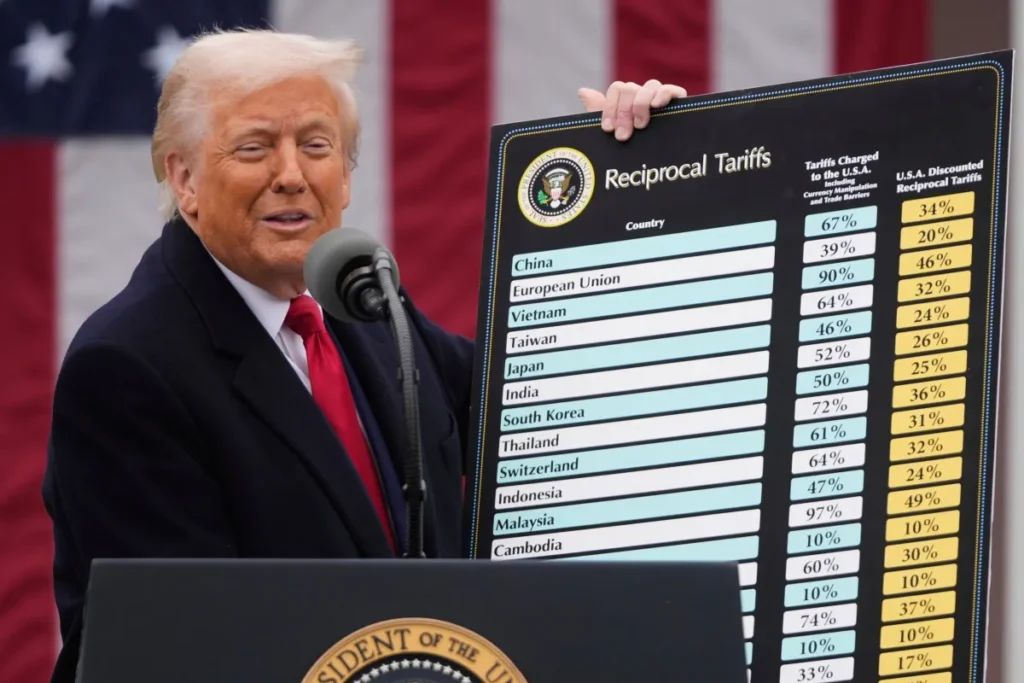
The US supreme court declared many of Donald Trump’s reciprocal tariffs illegal on Friday, 20 February 2026 in a sharp rebuke that topples a key pillar of the president’s aggressive economic agenda.
In a 6-3 ruling, the court decided that a 1977 law designed to address national emergencies did not provide the legal justification for most of the Trump administration’s tariffs on countries across the world. It is the first time the court has overruled one of Trump’s second-term policies.
By the court decision President Trump’s Reciprocal Tariff that declared on 2 April 2025 with in less than three months in his second presidency has effectively been annulled.
Donald Trump announced on Saturday that he would raise a temporary tariff rate on US imports from all countries from 10% to 15%, less than 24 hours after the US supreme court ruled against the legality of his flagship trade policy.
Annulment of Reciprocal Tariff relived Bangladesh exporters as it was initially levied 37% additional tariff on top of existing 15.5% tariff as a most favoured nation. Later, it was reduced from 37% to 20% in June 2025.
On February 9, however, Bangladesh’s interim administration in a rush to sign a trade agreement just three days before a national election. Eleven days later, the legal foundation of that agreement cracked. In the deal the reciprocal tariff reduced from 20% to 19% and the USA has granted duty-free or lower duty access to 2,500 Bangladeshi products, while Bangladesh allowed 4,400 American products either duty-free or at lower duty.
Garment items made from imported American cotton are allowed zero duty on export to the USA. Pharmaceutical products, fisheries, particle board, and all kinds of food items will also enjoy duty-free access to the US market.
According to the agreement, Bangladesh will have to buy $3.5 billion worth of US agricultural products and $15 billions of energy. The overall value of the deal would have risen further by purchasing of 14 Boeing aircraft by state-owned Biman for around US$ 3.0 billions.
In addition, Bangladesh committed to provide significant preferential market access for US industrial and agricultural goods, including: chemicals; medical devices; machinery and motor vehicles and parts; information and communication technology (ICT) equipment; energy products; soy products; dairy products; beef; poultry; and tree nuts and fruit, etc.
However, the fate of the Reciprocal Tariff Agreement is still uncertain, as President Trump may come up with new trade issues and bounds Bangladesh to agree on a set of new terms.


